
Roofing Websites Built to Turn Visitors Into Booked Calls
Fast, mobile-first, and structured the way search engines — and AI answer engines — need to rank roofing pages. Not a template with your logo on it.
No pressure.
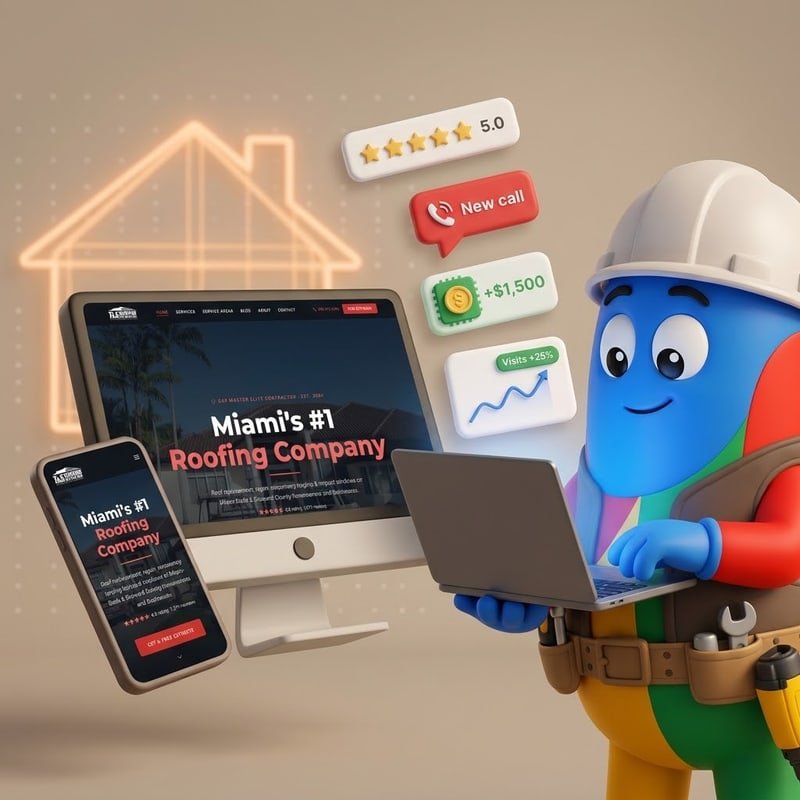
Why Your Roofing Website Decides Who Gets the Call
A homeowner picks a roofer the way they pick anything urgent: fast, on a phone, under stress, comparing two or three options in open browser tabs. The website is where most of that comparison happens — and it’s usually the reason one company gets ruled out before anyone picks up the phone.
It’s also the foundation the rest of the marketing stands on. A site that loads slow, has no roofing-specific structure, and gives visitors nothing to do next quietly undoes the reputation management and local SEO work happening everywhere else. Reviews and rankings get a homeowner to the site; the site has to turn them into a call.
Roofing demand moves in spikes, too — a hailstorm can push “emergency roofer” searches up 300–400% in a day. The company whose site already ranks and already converts captures that surge; storm season rewards whoever was already ready.
The rest of this page covers what a roofing website has to do, how it’s built to rank in Google and get cited in AI answers, what the build includes, and how long it takes.
Why a Professional-Looking Roofing Website Still Loses Jobs
Most roofing websites aren’t ugly. They’re a clean template with a logo dropped in, a stock photo of a roof, and a “Contact Us” page. It looks professional. It still loses jobs — because looking professional and being built to rank and convert are two different things.
- It loads slow on a phone. A homeowner standing in their driveway on cell data won't wait — and more than half of roofing traffic is on a phone.
- It has one “Services” page. Google can't tell you're an authority on metal roofs, storm damage, or commercial work when it's all one paragraph.
- Service areas are a comma-separated line. That isn't a page Google can rank for “roofer in [city].”
- There's no obvious next step — no click-to-call in the header, no short form, no financing — so visitors read, then leave.
- It was never structured for SEO, so the ranking work happening everywhere else is standing on a weak foundation.
What a Roofing Website Has to Do to Generate Leads
A roofing website has four jobs. Most templates do the first one — look the part — and none of the others.
- Load fast, on a phone. A few seconds at most, or the visitor is gone before the headline finishes rendering.
- Rank for what homeowners search. “Roof repair [city],” “metal roof cost,” “emergency roofer near me” — each needs its own page, structured the way search engines expect.
- Prove the work is real. Recent reviews, real project photos, license and manufacturer badges, warranty terms — placed where a homeowner is deciding, not buried on an “About” page.
- Get the call. Click-to-call in the header, a short form, financing up front. One clear next step on every page.
What's Included in Our Roofing Website Design
Every build covers the same foundation. What changes between roofing companies is how many service pages and service areas we’re building out.
Mobile-first build, tuned for speed
Designed for the phone first, since that’s where most roofing traffic is. Compressed images, minimal scripts, fast hosting — so the page is usable before a homeowner loses patience and taps back to the search results.
On-page SEO structure and schema
Title tags, heading structure, internal linking, and schema markup (LocalBusiness, Service, FAQ, Review) so search engines — and AI answer engines — can read exactly what you do, where you do it, and how you’re rated.
Service pages that can actually rank
A real page for each service that matters: repair, replacement, storm and insurance work, and any material or commercial specialties. Written around the terms homeowners actually search, not a generic bulleted list.
Service-area pages
A page per city or region you serve, with proof specific to that place, so you can rank for “roofer in [city]” instead of hoping one homepage covers a whole metro.
A conversion path on every page
Click-to-call header, short quote form, financing and trust signals placed where the decision happens. No page that dead-ends with nothing to do next.
Your domain, your site, your content
The domain stays in your name, the content is yours to keep, and there’s no clause that holds the site hostage if you ever decide to leave.
How Google Decides Who the Roofing Authority Is in Your City
Google ranks the business it can most confidently call the authority for a given search in a given place. On a website, that confidence comes from structure — the same structure that feeds your local SEO.
Service silos
Related pages grouped together — all your metal-roof content, all your storm-damage content — so each cluster reads as depth on a topic instead of a stray page here and there.
Geographic pages
A dedicated page for each service area, with content specific to that place. “Areas we serve: [long list]” on a single page tells a search engine almost nothing.
Internal linking
Pages linked to each other in a deliberate structure, so ranking strength flows toward the pages that bring in leads.
Schema and entity data
Structured markup that states plainly what your business is, what it does, where, and how it’s rated — the same signals that get a business cited in AI answers.
The page-count question
A one-service, one-city roofer might need 8–10 pages. A multi-service company across a metro can need 30 or more. The number follows your services and your service area, not a package tier — and a “5-page website” is almost never built to rank.
Getting a Roofing Website Cited in AI Answers
Homeowners increasingly start in ChatGPT, Perplexity, or Google’s AI Overviews, not a search bar. Those systems pull from sites that are structured, specific, and citation-worthy.
No one can guarantee placement inside an AI-generated answer — anyone who says otherwise is overselling a system nobody fully controls. What a well-built site does is give those systems something clean to quote: clear service definitions, real specifics (materials, warranties, process), consistent business data, and schema that spells it out. It’s the same structure that improves traditional rankings.
How a Roofing Website Turns Visitors Into Booked Calls
Ranking gets the visit. The page has to do the rest — usually in under a minute, from a phone, with two other roofers open in another tab.
- Click-to-call in the header, visible without scrolling, on every page.
- A short form — name, phone, what they need. Not a ten-field intake that never gets filled in.
- Financing and trust up front — monthly payment options, warranty terms, license number, manufacturer certifications, recent reviews.
- Real photos of completed roofs, not stock imagery.
- Speed — every extra second of load time is visitors leaving before they decide.
How Our Roofing Website Design Process Works
- 01
Strategy and structure. We map your services, your service area, and the searches that bring you the jobs you want — then plan the pages and how they link together.
- 02
Design and build. Mobile-first, on your branding, with copy written around roofing searches rather than filler.
- 03
SEO and schema pass. Speed, structured data, internal linking, metadata — the technical work that decides whether any of it ranks.
- 04
Launch. We move it live, check everything, map redirects if it's a rebuild, and hand over full access.
- 05
Ongoing technical SEO. After launch the site keeps getting monitored and tuned as part of local SEO work.
How Long a Roofing Website Build Takes
Most roofing sites take 4–8 weeks end to end. What moves the number is how many service and service-area pages we’re building and how fast content decisions get made. You’ll get a real timeline on the first call, based on what you actually need — not a fixed package clock.
Roofing Website Resources
A few ways to see where your current site stands before committing to anything:
- Free website audit — send your URL and we’ll send back a real review of speed, structure, and conversion gaps. Not an automated score.
- The blog — plain-English writing on roofing SEO, local search, and what actually moves rankings.
- A rough page-count rule: one service and one city is about 8–10 pages; add a service, +2–4; add a city, +1–2; multi-service across a metro, 30+. If a fixed “5-page package” is all you’re offered, it isn’t built to rank.
- Book a call — walk through your site, your market, and what a rebuild would actually involve.
Roofing Website Design FAQ
Either way. If you already have a site, we assess whether it’s worth rebuilding on or starting fresh — most templated sites are easier to replace than to retrofit. If you have nothing, we plan, design, and build from the ground up around your services and service area.
Calls Are
Always Free
Book a Call Free
Website Audit
Send us your site and we'll send back a real audit — no automated report.